Strategic Medical Billing Company Partnerships Driving Practice Expansion
On this page
Partnering with a Medical Billing Company helps dental practices manage operational growth through organized revenue-cycle workflows and performance tracking. Connected processes streamline claim submission, follow-up, and payment posting.
Expanding practices face administrative pressure across registration, coding, claims, denials, and accounts receivable. Changing payer requirements manually causes workflow gaps, claim delays, and increased staff workload.
This guide explores how partnering with a Medical Billing Company provides a scalable operating model, reduces administrative friction, and improves financial control as your practice grows.
What Is a Strategic Medical Billing Company Partnership?
A strategic Medical Billing Company partnership means assigning end-to-end revenue-cycle responsibilities to a dedicated external team. The team manages core tasks such as claim preparation, payer follow-up, denial tracking, payment posting, and A/R monitoring.
A structured process gives staff clear operational visibility and supports claims management with verified information. It also reduces the time front-office employees spend on administrative inquiries, documentation, and routine billing follow-ups.
Medical Billing services explain how external teams support growth through defined claim tracking, denial review, and reporting protocols.Medical Billing Challenges and Solutions further demonstrate how structured workflows resolve key operational obstacles.
What Practice Growth Challenges Can a Medical Billing Company Help Address?
Expanding practices face higher claim volumes and rising accounts receivable. Common operational challenges without a dedicated Medical Billing Company for expanding practices include:
- Delayed Payer Follow-Up: Internal staff lack time to routinely track unpaid claims and aging balances.
- Staffing Shortages: Turnover and limited billing staff create backlogs during high-volume periods.
- Limited Reporting Visibility: Practice leaders lack clear data to identify workflow gaps and track financial health.
Partnering with a Medical Billing partner resolves operational challenges through structured workflows and clear reporting.
What Are the Benefits of a Medical Billing Company for Practice Growth?
Partnering with a Medical Billing Company provides scalable operational infrastructure, improved process consistency, and clearer financial oversight as your practice expands:
1. Better Revenue-Cycle Coordination
- Connects registration, claims, payments, and denial management into one unified workflow.
- Assigns clear ownership to quickly resolve pending accounts.
2. Greater Administrative Capacity
- Expands operational capacity without hiring additional internal billing staff.
- Handles high claim volumes to prevent administrative backlogs.
3. Stronger Financial Visibility
- Provides clear reports on claim status, aging balances, and collections.
- Helps leadership pinpoint exact workflow bottlenecks.
4. Easier Scaling Across Locations
- Replicates standard billing procedures when expanding to new locations.
- Adapts shared protocols to site-specific payer needs.
The broader Medical Billing Role in Healthcare can also be useful when evaluating how billing professionals contribute to communication, claim resolution, and financial administration.
How Does a Medical Billing Company Improve Revenue Cycle Efficiency?
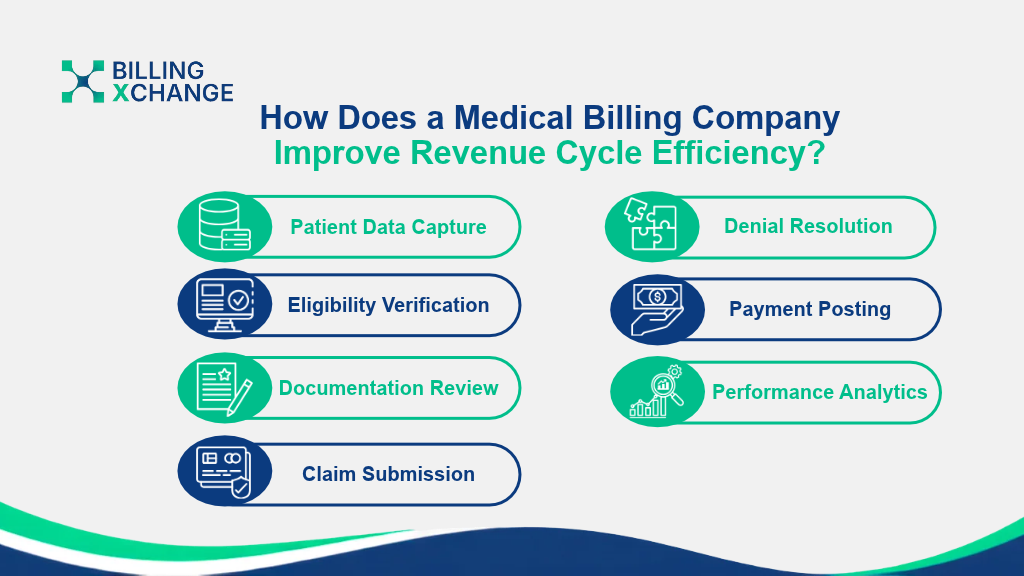
A Medical Billing Company reduces operational delays through structured checkpoints across every stage of the revenue cycle, ensuring clear ownership from intake to reporting.
Step 1: Patient Data Capture
- Data Accuracy: Capture complete demographic and insurance details at intake to prevent downstream delays.
- Intake Verification: Identify missing or inconsistent patient info early before claim preparation.
Step 2: Eligibility Verification
- Proactive Checks: Verify active benefits and coverage details prior to service delivery.
- Clean Foundation: Ensure accurate front-end details to support seamless claim submission.
Step 3: Documentation Review
- Coding Review: Verify procedure codes and clinical documentation against payer requirements.
- Error Prevention: Identify preventable coding mistakes and missing attachments before transmission.
Step 4: Claim Submission
- Electronic Transmission: Transmit clean claims promptly through designated electronic channels.
- Status Monitoring: Track claims active status to identify delayed, rejected, or pending submissions early.
Step 5: Denial Resolution
- Root Cause Analysis: Review rejection reasons and determine exact correction requirements.
- Structured Appeals: Resubmit or appeal denied claims using defined workflows to recover revenue.
Step 6: Payment Posting
- Accurate Posting: Record payments and adjustments to calculate remaining balances.
- A/R Recovery: Target unresolved insurance and patient balances through systematic follow-up.
Step 7: Performance Analytics
- Workflow Visibility: Track revenue trends to identify bottlenecks, denials, and aging accounts.
- Continuous Improvement: Use performance data to optimize front-end and back-end billing processes
Which Medical Billing KPIs Should Practices Track?
Selecting a Medical Billing Company requires establishing baseline performance metrics and tracking progress over time instead of relying on general promises.
1. Measurable Baseline Standards
- Rely on objective metrics instead of vague promises.
- Ensure data transparency across all billing operations.
2. Operational Stage Monitoring
- Track intake accuracy prior to claim submission.
- Monitor clean claim rates and processing speed.
3. Methodology Reporting
- Segment claims by payer and aging status.
- Measure performance across all office locations.
| KPIs | Focus |
| Clean Claim Rate | Accuracy of initial submissions |
| Denial Rate | Frequency of payer rejections |
| Days in A/R | Average outstanding revenue time |
| Aging Balance Distribution | Breakdown of unpaid balances by age |
| Net Collection Rate | Percentage of collectible revenue received |
What Should Practices Look for in a Medical Billing Company Partner?
Choosing a Medical Billing Company requires evaluating operational capabilities beyond service fees:
Specialty and Payer Expertise
- Align with partners experienced in your clinical specialty and payer rules.
- Navigate complex policies to prevent claim rejections.
Core Revenue-Cycle Execution
- Maintain standardized procedures for claims, payment posting, and denial management.
- Apply structured follow-up protocols for A/R recovery.
System and Process Integration
- Ensure compatibility with practice management software and workflows.
- Establish clear communication and escalation procedures.
Scalability and Compliance Controls
- Support multi-location expansion and new provider onboarding.
- Enforce strict data security and regulatory compliance.
The Medical Billing Company For Your Practice should provide clear operational transparency so practice leaders understand task ownership, internal responsibilities, and performance monitoring.
How Should a Practice Implement a Medical Billing Company Partnership?
A structured implementation can reduce disruption and create clearer accountability from the beginning.
1. Review the Existing Workflow
Document how the practice currently manages registration, eligibility, coding, claims, posting, denials, and A/R.
2. Identify Revenue-Cycle Gaps
Review rejection patterns, denial trends, aging balances, delayed payments, staffing limitations, and reporting gaps.
3. Define the Service Scope
Determine which responsibilities will remain internal and which activities will be handled by the billing partner.
4. Establish Communication Rules
Define points of contact, reporting schedules, escalation procedures, response expectations, and processes for urgent issues.
5. Coordinate the Transition
Provide the necessary system access, payer information, workflow documentation, open-claim details, and account information needed for an organized handoff.
6. Monitor KPIs After Implementation
Compare post-launch performance with the original baseline. Use the results to identify additional workflow changes and maintain continuous improvement.
Medical Billing Company Services and Practice Benefits
| Medical Billing Support | Practice Benefit |
| Claim Submission | Faster processing |
| Insurance Verification | Better coverage accuracy |
| Denial Management | Fewer unpaid claims |
| A/R Follow-Up | Faster collections |
| Payment Posting | Accurate account records |
| Medical Coding | Fewer billing errors |
Why Choose BillingXChange for Medical Billing Company Services?
Choosing BillingXChange for Medical Billing Company services starts with structured workflows that cover coverage checks, claim submission, payment posting, A/R recovery, and denial follow-up.
Review our billing expertise, transparent reporting, communication, and software compatibility. Clear reports provide full visibility into claim status, aging balances, payments, denials, and pending actions.
Consider scalability as your practice expands.BillingXChange supports practices with structured billing workflows, consistent account management, and clear operational reporting.
Conclusion
A Medical Billing Company partnership provides a structured approach to manage growing claim volume and administrative complexity by connecting front-end data with claims, denials, payment posting, A/R Recovery, and reporting.
Practice leaders should evaluate partners based on workflow quality, reporting, scalability, and measurable performance. A consistent workflow reduces avoidable errors and gives leadership complete financial visibility.
Partner with BillingXChange to simplify medical billing and improve financial operations. Book a Free Consultation now to learn more about our Medical Billing Company services.
Frequently Asked Questions
1. What does a Medical Billing handle?
It manages coverage checks, claim submissions, payer follow-up, denial resolution, payment posting, A/R recovery, and financial reporting.
2. Can a Medical Billing Company support multiple locations?
Yes. Standardized workflows and centralized reporting easily scale to support multiple providers and practice locations.
3. How is Medical Billing Company performance measured?
By tracking clean claim rates, denial rates, days in A/R, net collection rates, payment posting speed, and turnaround times.
4. When should a practice consider external billing support?
When claim volume expands, aging balances rise, follow-up becomes inconsistent, or internal staff struggles with complex billing.
5. What should a practice ask before choosing a partner?
Ask about specialty experience, claim workflows, software integration, reporting transparency, security, pricing, and key performance metrics.

BillingXchange team
Written by the BillingXchange team. We help dental and medical practices reduce denials, accelerate payments, and maximize collections through expert revenue cycle management.